Investing in Your Talent: The Key to Long-Term Success
Choosing Talent Based Career Path for Long Term Growth and Life Long Satisfaction
Harshal Garad
Career Counsellor · CareerSetu
Your Career is Your Largest and Life long Asset
A well-planned career is the only asset you own that has the potential for infinite growth through personal effort. While most Indian families prioritize physical investments, your ability to generate income is the engine that funds every other part of your life.
Growth Potential vs. Physical Assets
Traditional investments like gold or real estate are limited by market rates and supply. In contrast, your professional profile can see exponential growth when you align your natural talents with the right market opportunities.
| Asset Type | Primary Growth Driver | Typical Scale | Risk Level |
|---|---|---|---|
| Fixed Deposits | Interest Rates | Linear | Low |
| Real Estate | Market Location | Moderate | High Capital |
| Your Career | Skills & Strategy | Exponential | Managed |
Unlike a house that requires heavy maintenance, your career capital stays with you regardless of economic shifts. When you invest in scientific career planning, you are essentially upgrading the quality of your most productive asset.
Investing in your own potential provides a higher return on investment (ROI) than any stock market index because you control the outcome.
By focusing on specialized expertise and a clear career roadmap, you ensure that your value in the talent market continues to rise year after year. This foundation allows you to outpace inflation and build long-term wealth far more effectively than passive saving alone.
Choosing Talent Vs Choosing Trend
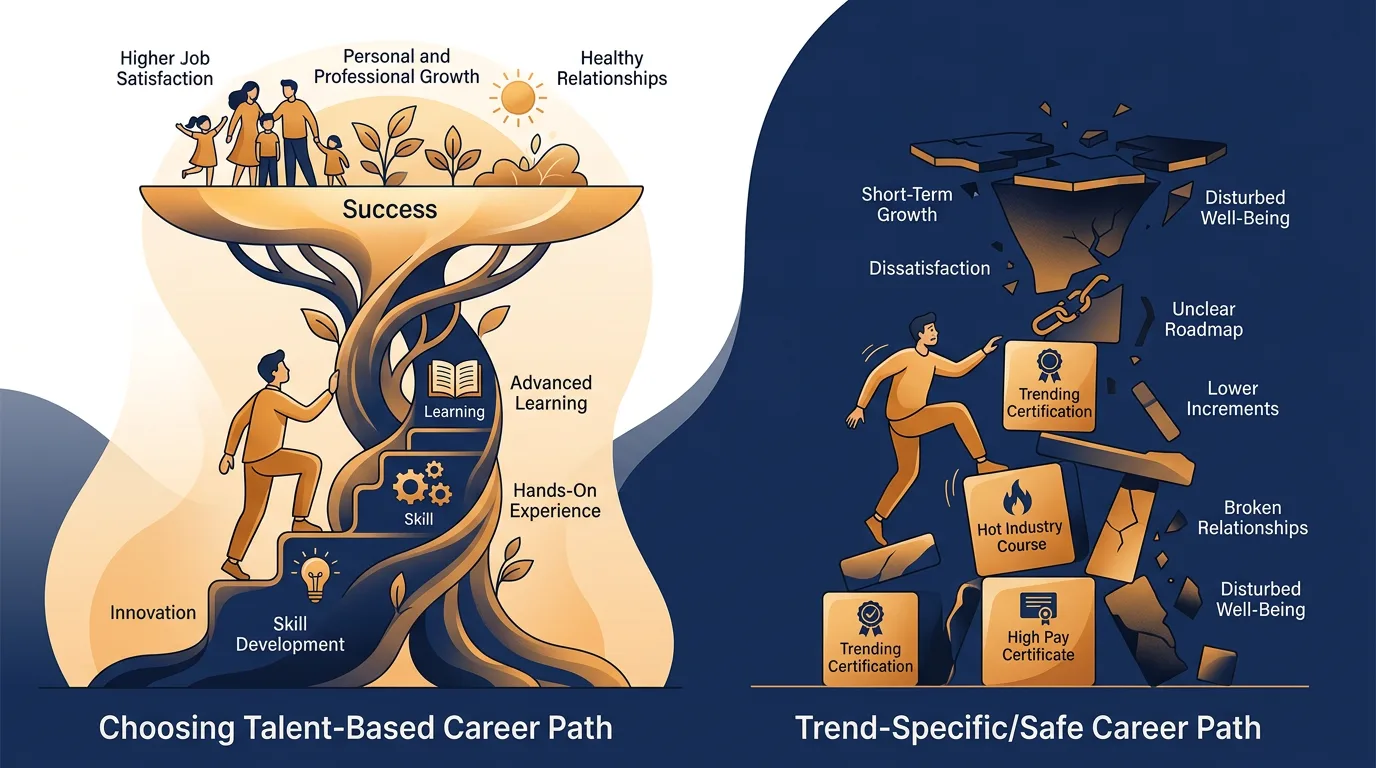
Choosing a career based on your natural aptitude ensures long-term resilience, whereas following trends often leads to professional stagnation when the market shifts. Many students chase "safe" careers like Engineering or Medicine simply because they are popular, only to find themselves struggling in a crowded market. A talent-based path allows you to leverage your unique strengths, making it easier to become an expert and command higher value.
Comparing Talent vs. Trends
While a trend-specific path might offer a quick start, a path built on your personality and interests provides a foundation that survives economic changes.
| Feature | Trend-Specific / "Safe" Path | Talent-Based Path |
|---|---|---|
| Motivation | External (Salary, Peer pressure) | Internal (Passion, Natural ease) |
| Competition | Extremely high and generic | Niche and specialized |
| Sustainability | Risk of becoming obsolete | High growth through mastery |
| Outcome | Average performance | Peak professional excellence |
Building a career on your core strengths means you are not just working; you are evolving in a field where you have a natural advantage. To identify these strengths, scientific psychometric assessments are essential to move beyond guesswork.
Key Tip: A "safe" career is only safe if you are good at it; being an average performer in a popular field is riskier than being a top performer in a niche one.
By following a personalised career roadmap, you can transition from chasing temporary trends to building a legacy based on your natural aptitude.
Career ROI vs. Traditional Investments
- Fixed Deposits (Linear): 1 Growth Scale (1-5)
- Real Estate (Moderate): 3 Growth Scale (1-5)
- Your Career (Exponential): 5 Growth Scale (1-5)
The Power of Compounding Skills
Building a specialized skill set acts like a high-interest savings account for your professional life, where every new ability increases the value of your existing knowledge. When you learn a skill, you don't just add to your toolkit; you multiply the impact of everything you already know. Over a 30-year career, this niche expertise creates a massive gap between those who stop learning and those who grow.
How Skill Stacking Works
When you combine different areas of expertise, you become rarer and more valuable in the job market. This creates a compounding effect where your income potential grows exponentially rather than linearly.
| Skill Level | Market Position | Impact on Income |
|---|---|---|
| Generalist | Easily replaceable | Standard market rates |
| Specialist | High demand | Premium professional fees |
| Expert (Stacked) | Unique & Irreplaceable | Maximum leverage and growth |
To harness this power, you must focus on scientific psychometric assessments to identify which skills naturally suit your personality. This ensures you are building on a solid foundation rather than fighting your natural instincts.
Key Takeaway: A 1% improvement in your core competencies every month does not just make you 12% better in a year; it builds a unique professional brand that attracts better opportunities automatically.
By focusing on a personalised career roadmap, you can ensure that the skills you acquire today will remain relevant and lucrative decades from now.
Treat Continuous Learning as your regular SIP
Allocating time to upgrade your skills every month works exactly like a Systematic Investment Plan (SIP), where small, consistent efforts build massive professional wealth over time. Just as you wouldn't expect a single deposit to fund your retirement, you cannot expect a single degree to carry you through a 40-year career. By committing to ongoing mentorship and skill acquisition, you protect yourself against industry changes and keep your career capital growing.
How to Build Your Learning Portfolio
To treat learning like a financial investment, you need a structured approach rather than random courses. This ensures that every hour spent contributes to your personalised career roadmap and long-term goals.
- Identify the Gaps: Use scientific psychometric assessments to find where your current skills meet your natural interests.
- Budget Your Time: Dedicate at least 3–5 hours a week to learning a new tool or soft skill related to your career cluster.
- Apply Immediately: Test your new knowledge through projects or internships to turn theory into practical expertise.
- Review Progress: Schedule a 1-on-1 expert mentoring session quarterly to adjust your learning path based on market shifts.
Consistency beats intensity; studying for 30 minutes daily is more effective for skill retention than a 10-hour marathon once a month.
By staying curious and disciplined, you ensure that your market value never plateaus. This proactive habit transforms you from a job seeker into a highly sought-after professional who stays ahead of the curve.
The High Cost of Career Errors
Choosing a career path without proper data leads to wasted years and significant financial loss.
Many students select degrees based on peer pressure or trends, only to realize midway that they lack the natural aptitude for the field. This misalignment results in "sunk costs" where thousands of rupees are spent on tuition and coaching that never yield a return. Beyond money, the emotional toll of feeling stuck in the wrong profession can lead to burnout and stalled growth.
The Real Price of a Wrong Turn
When you make an uninformed career choice, the losses extend beyond the immediate college fees. You must consider the opportunity cost—the income and experience you lose by not being in a field where you could excel.
| Type of Loss | Impact on Your Future |
|---|---|
| Direct Costs | Wasted tuition fees, hostel expenses, and entrance exam coaching. |
| Time Loss | Spending 3–4 years earning a degree you will never use. |
| Career Lag | Starting from zero in a new field while peers have already been promoted. |
| Mental Cost | Reduced confidence and chronic stress from performing tasks that do not match your personality. |
A single year of "course correction" later in life often costs ten times more than getting an expert roadmap at the start.
Professional planning helps you identify these risks before you sign up for a degree. By using scientific psychometric assessments, you can ensure your career choice aligns with your strengths, saving you from expensive pivots later. Avoiding just one wrong degree can save a family lakhs of rupees and years of frustration.
Start Building Your Career Capital
Directing your time and energy toward a structured professional strategy ensures that every effort you make yields long-term dividends. Career planning acts as a bridge between your current abilities and your future potential, transforming random jobs into a cohesive, high-value trajectory. By aligning your natural strengths with market demands, you stop reacting to the job market and start leading it.
Take the First Step Toward Growth
Personalised mentorship provides the clarity needed to navigate complex educational and professional landscapes. Whether you are a student choosing a stream or a professional looking for a meaningful shift, the right guidance removes the guesswork from your journey.
| Feature | Benefit to You |
|---|---|
| Psychometric Assessments | Identifies your unique aptitude and personality. |
| Personalised Roadmap | Maps out the best-fit courses and colleges. |
| Ongoing Mentorship | Provides continuous support for long-term goals. |
Key Takeaway: A well-planned career is a hedge against economic shifts and ensures your professional value continues to rise.
Investing in Your Future Today
Building a high-value career starts with intentional choices rather than accidental growth. While many wait for opportunities to arrive, proactive professionals and students create their own paths by identifying their strengths early. This shift from a passive mindset to an active investment strategy ensures you stay relevant in a changing job market.
Steps to Begin Your Professional Development
- Self-Assessment: Begin by evaluating your natural aptitude and interests to find where your potential lies.
- Strategic Planning: Use the Free Discovery Session to speak with an expert and identify high-growth career clusters.
- Skill Acquisition: Focus on learning skills that bridge the gap between your current profile and your best-fit career.
- Mentorship: Connect with a mentor like Harshal Garad to get ongoing support and avoid common industry pitfalls.
Tip: Treat your career planning as a long-term project; even thirty minutes of expert guidance can save you years of heading in the wrong direction.
The following table compares different ways to approach your growth:
| Approach | Focus | Long-term Outcome |
|---|---|---|
| Traditional | Degree certificates | General employability |
| Skill-Based | Specific technical tools | Niche market demand |
| CareerSetu Plan | Personalised Roadmap | High-growth alignment |
By starting with a scientific psychometric assessment, you remove the guesswork from your future. This data-driven approach allows you to invest your time and energy only in paths that offer the highest return on effort.
Common Questions About Investing in Your Talent
Common Questions About Career Investment
Frequently Asked Questions
Keep reading
More guides on the same topic.
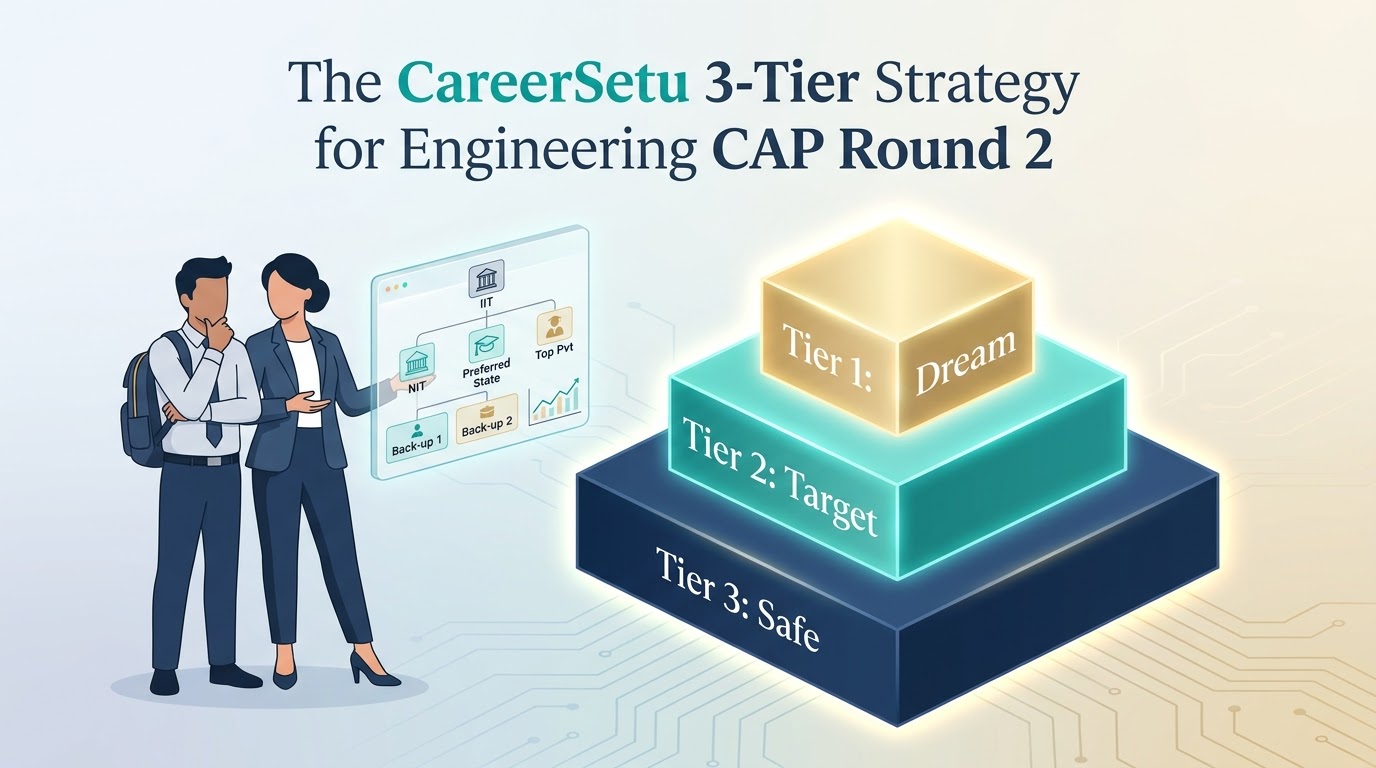
The CareerSetu 3-Tier Strategy for Engineering Admission Cap Round 2
Never place a Tier 3 (safe) college above a Tier 1 or Tier 2 college.
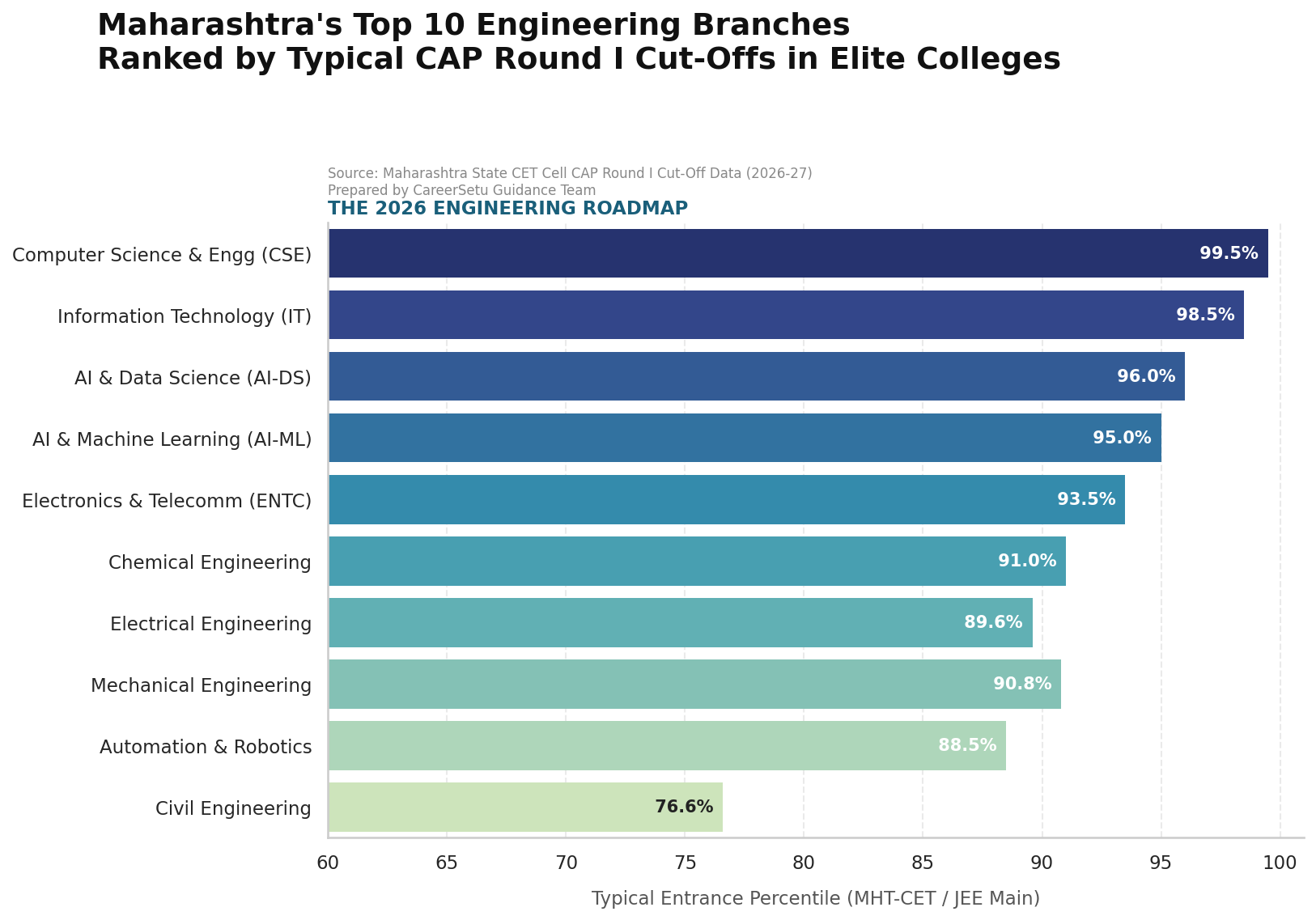
Engineering Cap Round-1 Cutoffs- Top 10 Branches Preferred by Students
The Engineering CAP Round 1 cut-offs are out, showing high demand for CSE, IT, and AI branches. Learn how to use this data for your Round 2 strategy and avoid the common herd mentality trap.
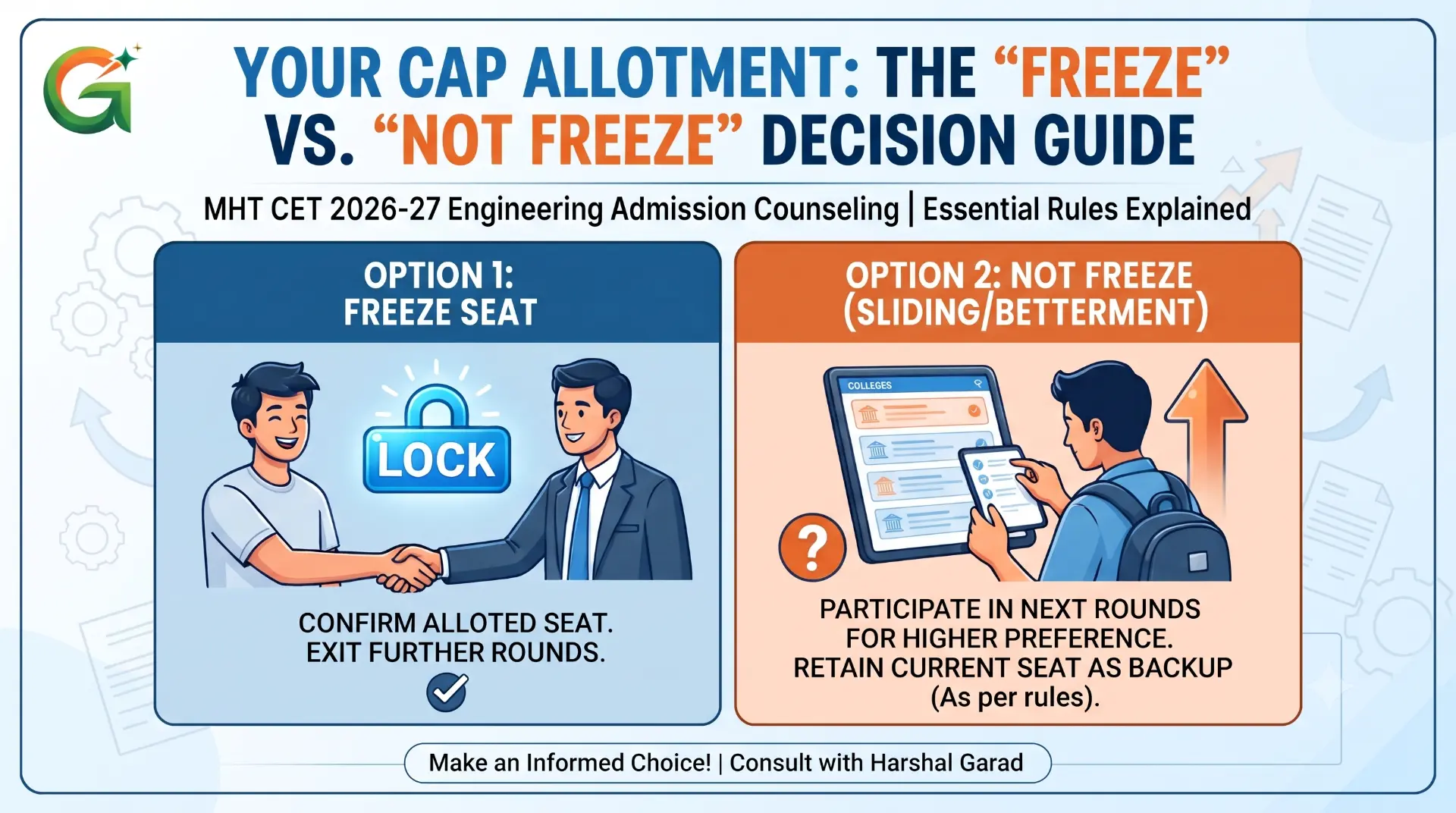
CAP Allotment: Students Decision Guide on "Freeze" vs. "Not Freeze".
Your CAP Allotment Guide for Students Explaining The "Freeze" vs. "Not Freeze" options