How Understanding Your Learning Style Boosts Your Career Growth
Discover how identifying your unique learning style—Visual, Auditory, Read-Write, or Kinesthetic—can transform your academic performance. Learn practical strategies to master new skills faster throughout your career.
Harshal Garad
Career Counsellor · CareerSetu
Why You Struggle to Learn Certain Things
Traditional education often fails because it assumes everyone learns the same way, but brains process information differently. Most classrooms rely on lectures and textbooks, which may not suit every student. When your study method clashes with your natural style, you might feel less capable than you actually are. Identifying your VARK learning style—Visual, Auditory, Read/Write, or Kinesthetic—allows you to tailor study habits and professional training to your brain's natural processing strengths. By aligning your methods with your style, you improve information retention, speed up upskilling, and reduce academic frustration.
| Learning Challenge | Possible Reason | Recommended Shift |
|---|---|---|
| Zoning out during lectures | You might be a Visual or Kinesthetic learner. | Use diagrams or hands-on practice. |
| Struggling with long manuals | You might prefer Auditory or Visual inputs. | Use text-to-speech or video guides. |
| Forgetting facts quickly | You may be using the wrong memorization technique. | Try active recall or mind mapping. |
A "one-size-fits-all" approach to education often leads to frustration rather than mastery.
The VARK Model: Finding Your Fit
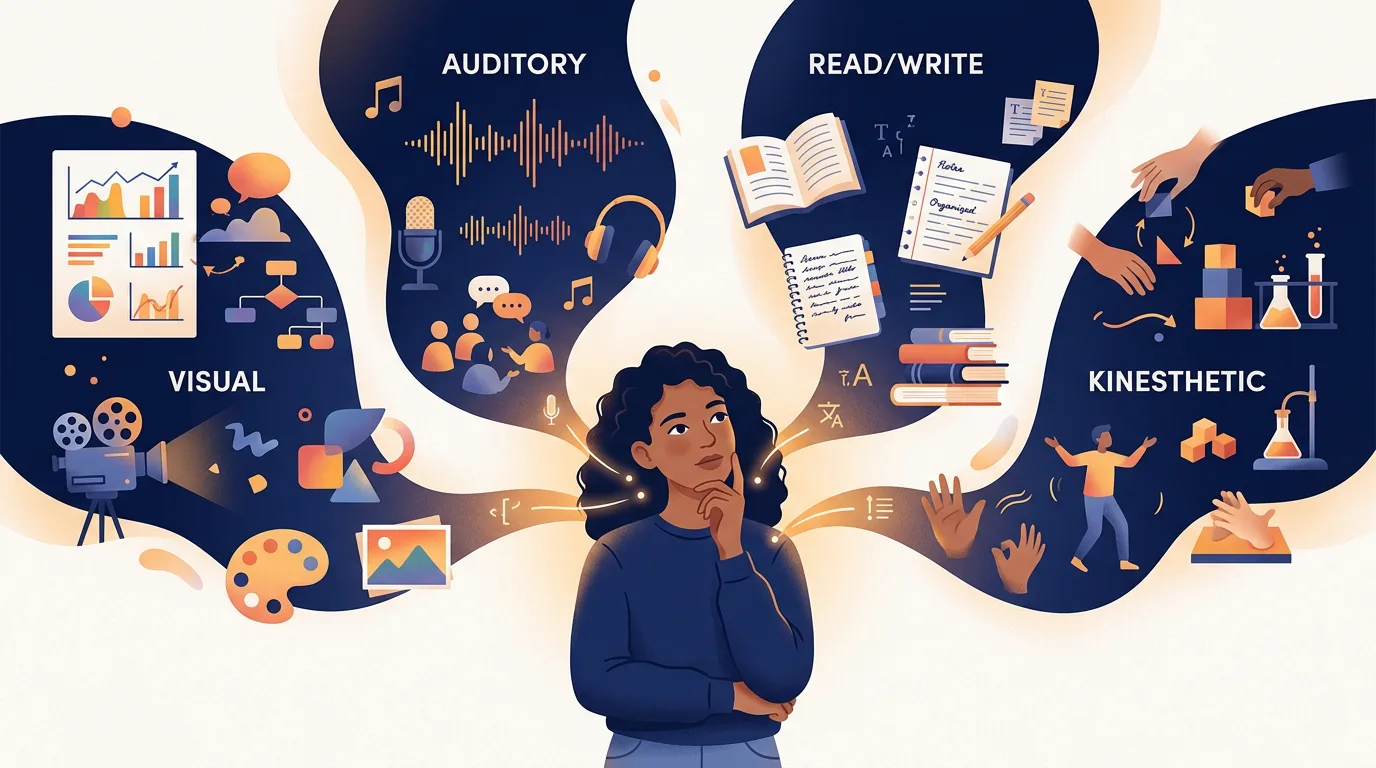
The VARK model categorizes how we take in information into four primary styles: Visual, Auditory, Read/Write, and Kinesthetic. Understanding these helps you stop fighting your natural instincts and start using your strengths.
Identifying Your Style
- Visual: You prefer maps, charts, and diagrams. You often say, "I see what you mean."
- Auditory: You learn best through listening and talking. You prefer podcasts and group discussions.
- Read/Write: You love lists, notes, and text-based presentations. You are comfortable with essays.
- Kinesthetic: You learn by doing. You prefer hands-on practice, examples, and physical movement.
Strategies to Supercharge Your Performance
Tailoring your study habits to your VARK style can significantly improve your memory and speed. Once you know your style, you can transform boring tasks into engaging activities.
Custom Strategies for Every Learner
- Visual Learners: Use highlighters, draw mind maps, and watch educational videos or documentaries.
- Auditory Learners: Record your notes and listen to them. Explain concepts out loud to a friend or even to yourself.
- Read/Write Learners: Rewrite your notes in your own words. Turn diagrams into written descriptions and bullet points.
- Kinesthetic Learners: Use real-life examples to understand theories. Take frequent breaks and try "active study" like walking while reading.
If you are an auditory learner, try explaining a difficult concept to a family member to lock it into your memory.
Upskilling and Career Growth
Professional growth requires constant learning, and knowing your style helps you master new job skills faster. Whether you are learning a new software or a management technique, applying VARK principles saves time.
- Online Courses: A visual learner should pick courses with high-quality graphics and videos.
- Workshops: Kinesthetic professionals should choose interactive workshops over passive webinars.
- Technical Manuals: Read-write learners excel here by taking detailed notes during training.
- Meetings: Auditory learners should ask for permission to record meetings to review instructions later.
The Power of Multimodal Learning
Most people are not strictly one style but a mix, which is known as multimodal learning. While you might have a dominant preference, using multiple senses can make your brain create stronger connections.
- Combine listening to a lecture with drawing a concept map.
- Read a manual and then perform a hands-on task related to the text.
- Watch a video (Visual) and then discuss it in a group (Auditory).
- Create a flashcard (Read/Write) and use it while walking (Kinesthetic).
Using more than one learning style at once is like giving your brain multiple paths to find the same information.
Final Thoughts for Lifelong Learners
Identifying your unique learning style is a permanent advantage that helps you succeed in school, college, and your career. You don't have to guess your strengths alone. CareerSetu offers a scientific way to map your potential and plan your future.
Our Discover, Design, and Deliver process helps you find the right path:
- Start with a Free Discovery Session to discuss your goals with an expert.
- Take scientific psychometric assessments to identify your learning style, interests, and aptitude.
- Get a personalized career roadmap that includes best-fit careers and courses.
- Receive one-on-one expert mentoring from Harshal Garad and the team for ongoing support.
To begin your journey, call or WhatsApp +91 8411939257 today.
The Multimodal Learning Workflow
- 1
Step 1
Input
Attend a lecture or watch a video (Visual/Auditory).
- 2
Step 2
Process
Take notes or draw a mind map of what you learned (Read-Write/Visual).
- 3
Step 3
Reinforce
Explain the concept to someone else or try a hands-on task (Auditory/Kinesthetic).
Check your learner type by your preferred learning habits.
If you learn fast and remember information easily by :
- Maps, charts, and diagramsThen You are a Visual learner. Use highlighters, mind maps, and watch educational videos.
- Listening, podcasts, and talkingThen You are an Auditory learner. Record your notes to listen later or explain concepts out loud.
- Lists, notes, and essaysThen You are a Read/Write learner. Rewrite notes in your own words and use bullet points.
- Hands-on practice and movementThen You are a Kinesthetic learner. Use real-life examples and try walking while reading.