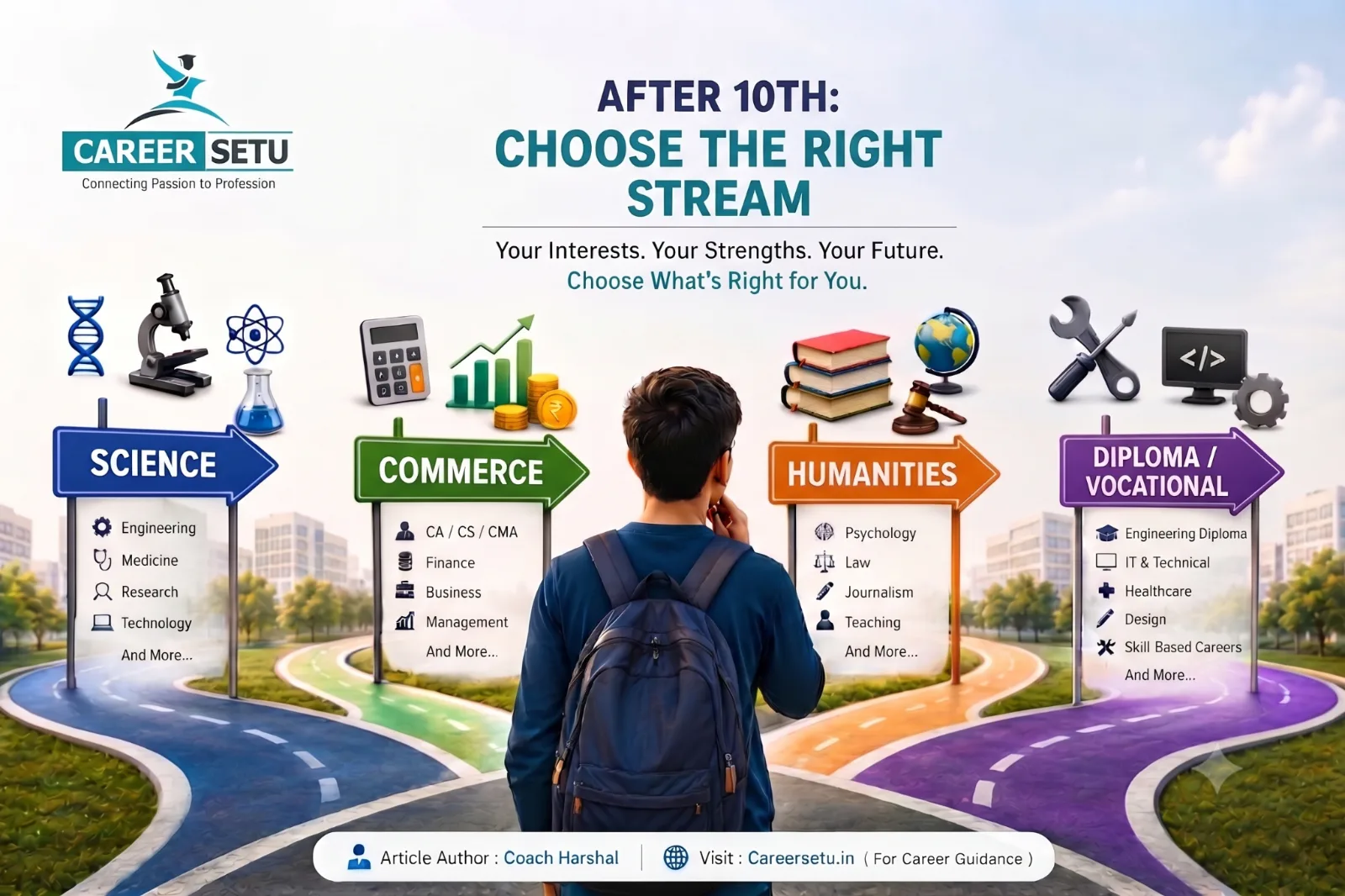
Best Commerce Careers After 12th: A Guide for Students & Parents
The Evolving World of Commerce which every Commerce student should keep an eye on.
Harshal Garad
Career Counsellor · CareerSetu
Beyond the Balance Sheet: Modern Commerce
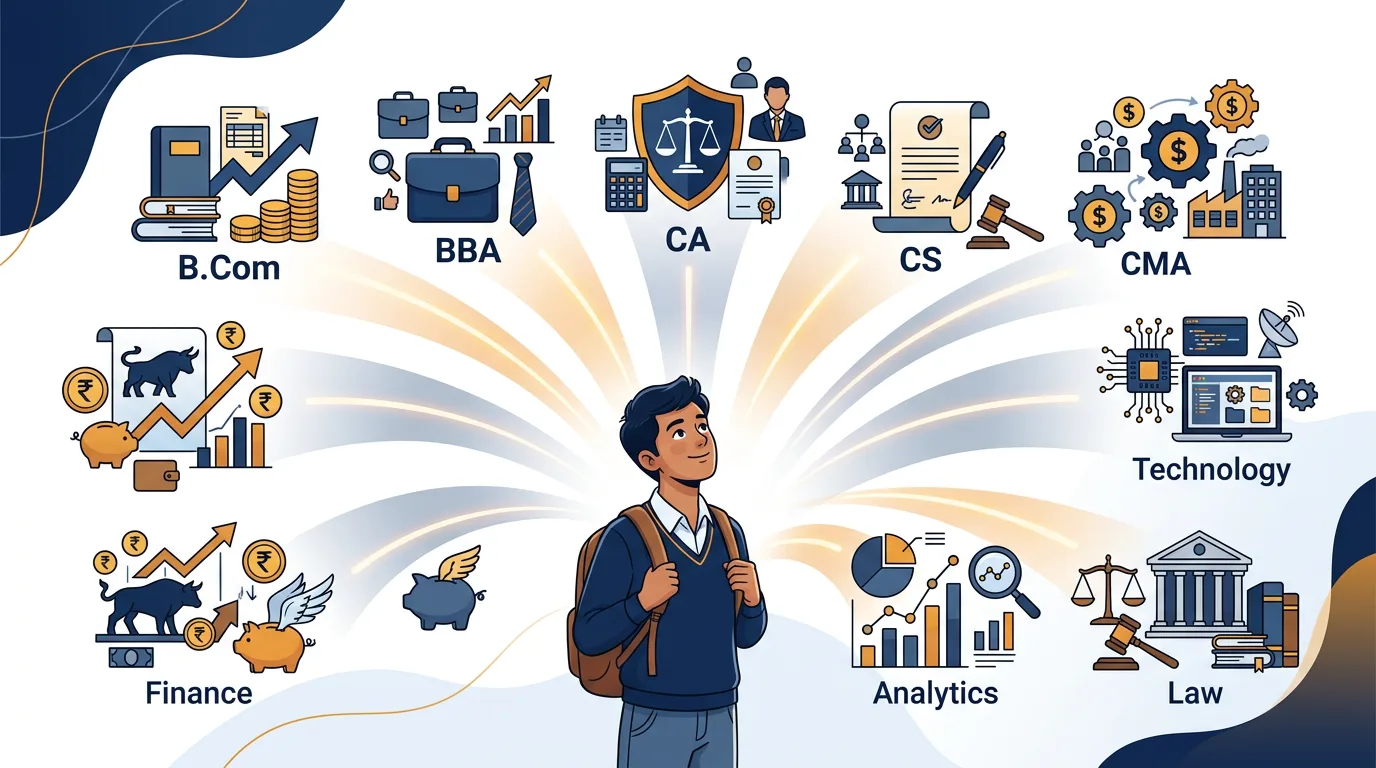
Commerce is no longer just about maintaining ledgers or preparing for the CA exams; it has evolved into a diverse field spanning technology, law, and management. Many students mistakenly believe that if they do not become a Chartered Accountant, their career options are limited.
Expanding Horizons
In reality, the modern economy requires commerce professionals who understand how global markets, consumer behavior, and digital systems work together. You can now explore specialized roles that didn't exist a decade ago.
| Career Path | Primary Focus | Industry Demand |
|---|---|---|
| Investment Banking | Capital raising and mergers | High (Global Finance) |
| Supply Chain Management | Logistics and operations | Growing (E-commerce) |
| Actuarial Science | Risk and probability | High (Insurance/Data) |
Why the Field is Growing
The shift from traditional roles to specialized careers is driven by three main factors:
- Digital Transformation: Businesses now need experts to manage online financial transactions and data.
- Global Trade: Companies require professionals who understand international trade laws and foreign exchange.
- Startup Culture: New ventures need versatile individuals who can handle both Business Operations and Financial Planning.
Choose a path based on your natural strengths rather than just following the most popular certification in your peer group.
By looking beyond traditional roles, you can find a career that matches your aptitude and long-term interests. The modern commerce landscape offers a seat for everyone, from the math-heavy analyst to the creative strategist.
Foundation Degrees: B.Com vs BBA vs BMS
Choosing the right degree depends on whether you want a broad academic base or specific management training. While all three degrees lead to corporate roles, they differ in their curriculum focus and the skill sets they build.
| Feature | B.Com (General/Hons) | BBA | BMS |
|---|---|---|---|
| Primary Focus | Accounting, Finance, & Audit | Management & Leadership | Management & Operations |
| Curriculum | Theory-heavy & Academic | Application-based & Case studies | Practical & Analytical |
| Best Suited For | Professional exams like CA or CS | Future MBA aspirants | Operations & Problem-solving |
Deciding Your Focus
B.Com is the most traditional route, providing a deep understanding of accounts and economics. It is often the preferred choice for students who plan to sit for professional certifications simultaneously.
BBA (Bachelor of Business Administration) and BMS (Bachelor of Management Studies) are more professional in nature. They focus on soft skills, team handling, and business logic. While BBA is often broader, BMS tends to focus more on the administrative and analytical aspects of running a business.
Tip: If you are unsure about your specialization, a B.Com offers the most flexibility to switch to different finance fields later, while BBA is better for networking and personality development.
Before choosing, check the specific college syllabus on their official portal to see which subjects align with your strengths.
The Gold Standards: CA, CS, and CMA
Chartered Accountancy, Company Secretaryship, and Cost Accountancy remain the most prestigious professional qualifications for commerce students due to their deep industry authority. These certifications are issued by statutory bodies and require passing multiple levels of exams along with mandatory practical training.
Understanding the Roles
While all three involve finance, their core focus areas differ significantly:
| Qualification | Core Focus Area | Primary Responsibility |
|---|---|---|
| Chartered Accountant (CA) | Auditing & Taxation | Financial reporting and tax compliance |
| Company Secretary (CS) | Corporate Law | Legal compliance and board advisory |
| Cost & Management Accountant (CMA) | Costing & Management | Improving operational efficiency and pricing |
The Path to Success
To earn these titles, students must clear the Foundation, Intermediate, and Final stages. The journey is rigorous, often taking 4 to 5 years of consistent study alongside an articleship (practical internship).
- CA (ICAI): Focuses heavily on accounting standards, auditing practices, and complex tax laws.
- CS (ICSI): Ideal for students with a strong interest in legal frameworks, corporate governance, and secretarial audits.
- CMA (ICMAI): Best suited for those who want to work in manufacturing or service industries to manage production costs.
Tip: These courses require high levels of discipline and self-study; ensure your interest in numbers or law is genuine before committing years to the grind.
Emerging Frontiers: Tech and Creativity in Commerce
Commerce today is no longer confined to ledgers, as it now blends seamlessly with data science, creative strategy, and interdisciplinary thinking. This shift allows students to move beyond traditional roles and enter high-growth industries that value both numbers and innovation.
Data and Digital Strategy
The rise of the internet has created a massive demand for professionals who can interpret consumer behavior. Data Analytics involves using statistical tools to help businesses make smarter decisions, while Digital Marketing focuses on building brand presence through online channels.
| Career Path | Key Focus Area | Common Skills Needed |
|---|---|---|
| Data Analytics | Interpreting business trends | Statistics, Excel, SQL |
| Digital Marketing | Online brand growth | SEO, Content Strategy, Ads |
| FinTech | Technology in finance | Digital payments, Blockchain |
The Liberal Arts Approach
Modern employers often look for "T-shaped" professionals who have deep knowledge in one area but a broad understanding of others. A degree in Liberal Arts allows commerce students to study Economics or Finance alongside subjects like Psychology or Sociology. This creates a well-rounded profile suitable for roles in Public Policy, Research, or Creative Directing.
Tip: If you enjoy solving puzzles and working with patterns, look into Business Intelligence roles that bridge the gap between IT and Finance.
These paths are ideal for students who want to combine their analytical commerce background with a modern, tech-driven workplace.
How to Choose: The Selection Criteria
Choosing the right career path requires a deep understanding of your unique profile instead of simply following popular trends. Making a decision based on what your peers are doing often leads to burnout or dissatisfaction later in life.
The Three Pillars of Choice
To find a career that truly fits, you must evaluate three core areas of your psychology.
| Criteria | What it means | Why it matters |
|---|---|---|
| Interest | What you enjoy learning about. | Sustains motivation during long study hours. |
| Aptitude | Your natural ability to perform tasks. | Determines your ease in mastering technical skills. |
| Personality | Your traits and behavioral patterns. | Ensures you thrive in the specific work environment. |
Steps to Evaluate Your Path
- Identify Strengths: List subjects where you score well without excessive effort; this often indicates high aptitude.
- Assess Work Style: Decide if you prefer structured, rule-based work like Accounting or creative, fluid environments like Marketing.
- Check Long-term Goals: Research the daily routine of a professional in your chosen field to see if it matches your personality.
- Seek Expert Input: Consult a mentor to validate your findings through scientific psychometric assessments.
Never pick a professional course like CA or Law just because it sounds prestigious; ensure your numerical reasoning or verbal ability actually aligns with the curriculum requirements.
Navigating the Choice with CareerSetu
CareerSetu simplifies your career decision by combining scientific data with expert guidance to ensure you choose a path that fits your natural strengths. Choosing between a professional course like CA or a creative field like Digital Marketing can be overwhelming without a clear plan.
Our 3-Step Success Process
We follow a structured method to move you from confusion to a clear career destination:
- Discover: You take scientific psychometric assessments that map your interests, aptitude, and personality.
- Design: We build a personalised career roadmap featuring the best-fit colleges and courses for your profile.
- Deliver: You receive ongoing mentorship and execution support to help you reach your goals.
Why Expert Mentoring Matters
While exams tell you what you know, our mentors tell you who you can become. Led by Harshal Garad, our team helps you look beyond just the degree.
| Feature | What You Get |
|---|---|
| Assessments | Scientific tests for interest, aptitude, and personality. |
| Scope | Guidance across 20 clusters and 3000+ occupations. |
| Support | One-on-one expert mentoring and follow-up help. |
Pro Tip: Don't pick a career based on what your friends are doing; use a scientific assessment to find where your own potential lies.
To start your journey, you can book a Free Discovery Session. This no-obligation call is the first step toward a secure future. For more details, call or WhatsApp +91 8411939257.
Final Checklist for Commerce Students
Choosing a career after Class 12 requires balancing your academic strengths with long-term professional goals. It is easy to feel overwhelmed by the variety of degrees and certifications available, so a structured approach is necessary.
Key Decision Factors
Before submitting your college applications, ensure you have evaluated these four critical pillars of career planning:
- Aptitude vs. Interest: Confirm that you not only like a subject but also possess the natural ability to handle its technical demands.
- Course Duration: Account for the time required, as professional certifications like CA often take much longer than a standard B.Com degree.
- Financial Investment: Compare the tuition fees of private management institutes against the cost of professional government-regulated bodies.
- Future Scope: Research how automation and AI might change your chosen role over the next decade.
Next Steps for Success
Follow these steps to streamline your transition from school to higher education:
- Verify Deadlines: Check the official websites for entrance exams like CUET, IPMAT, or SET, as dates change annually.
- Consult Experts: Speak with seniors or professionals currently working in the fields you are considering.
- Self-Assessment: Use scientific tools to identify if your personality aligns with a desk-heavy role or a client-facing management position.
Tip: Do not choose a path just because your friends are doing it; your unique aptitude should be the primary driver of your career choice.
Foundation Degrees in Commerce
B.Com (General/Hons)
Eligibility: Class 12 Commerce
Deep understanding of accounts and economics; provides flexibility for finance fields.
BBA (Bachelor of Business Administration)
Eligibility: Class 12 Commerce/Any stream
Focuses on management, leadership, soft skills, and personality development.
BMS (Bachelor of Management Studies)
Eligibility: Class 12 Commerce/Any stream
Concentrates on administrative aspects, operations, and analytical problem-solving.
Key Career Roles in Commerce
Chartered Accountant (CA)
Skills: Auditing, Taxation, Financial Reporting
Pathway: ICAI (Foundation, Intermediate, Final + Articleship)
Company Secretary (CS)
Skills: Corporate Law, Legal Compliance, Board Advisory
Pathway: ICSI (Foundation, Intermediate, Final + Training)
Cost & Management Accountant (CMA)
Skills: Costing, Management, Operational Efficiency
Pathway: ICMAI (Foundation, Intermediate, Final)
Business Operations Manager
Skills: Management, Soft Skills, Problem-solving
Pathway: BBA / BMS / MBA
Data Analyst
Skills: Statistics, Excel, SQL, Interpreting Trends
Pathway: Technical Certifications / Commerce Degree
Frequently Asked Questions about Commerce Careers
Keep reading
More guides on the same topic.